> ## Documentation Index
> Fetch the complete documentation index at: https://sequinstream.com/docs/llms.txt
> Use this file to discover all available pages before exploring further.
# Sink to Cloudflare Pipeline and R2 Bucket
> Learn how to sink every change in your database to a Cloudflare R2 bucket using a Cloudflare Pipeline.
Sequin already integrates with Cloudflare's growing data platform. Using a [Webhook Sink](/reference/sinks/webhooks), you can stream every change in your database to a Cloudflare [Pipelines](https://developers.cloudflare.com/r2/pipelines/) and ultimately into an R2 bucket. This approach comes with two key benefits:
* **High-throughput ingestion:** Cloudflare Pipelines can handle massive scale, processing tens of thousands of requests per second via Cloudflare's global network.
* **Zero egress fees:** With Cloudflare R2, you never pay to access your data regardless of how much you query or where you analyze it from.
With every change in your database in R2, you are set up for analytics, long-term archival, or for audit and compliance use cases.
This guide will show you how to setup and connect a Cloudflare pipeline, R2 bucket, and Sequin Webhook Sink to reliably capture every database change.
## Prerequisites
You'll create a Webhook Sink that'll deliver a database change to a Cloudflare Pipeline. You'll need the following to get started:
* A [Cloudflare account](https://dash.cloudflare.com/sign-up?utm_source=sequin.com)
* The Cloudflare [CLI installed](https://developers.cloudflare.com/workers/get-started/guide/)
* Sequin running [locally](/running-sequin)
* A [database connected to Sequin](/connect-postgres) with at least one table
```sql theme={null}
-- Create a users table
create table users (
id uuid primary key default gen_random_uuid (),
first_name text not null,
last_name text not null,
email text not null unique,
created_at timestamptz default now(),
updated_at timestamptz default now()
);
-- Insert some mock data
insert into
users (first_name, last_name, email)
values
('John', 'Doe', 'john.doe@example.com'),
('Jane', 'Smith', 'jane.smith@example.com'),
('Alice', 'Johnson', 'alice.johnson@example.com'),
('Bob', 'Brown', 'bob.brown@example.com'),
('Charlie', 'Davis', 'charlie.davis@example.com'),
('Emily', 'Wilson', 'emily.wilson@example.com'),
('Frank', 'Miller', 'frank.miller@example.com'),
('Grace', 'Moore', 'grace.moore@example.com'),
('Hannah', 'Taylor', 'hannah.taylor@example.com'),
('Isaac', 'Anderson', 'isaac.anderson@example.com');
```
## Setup a Cloudflare Pipeline and R2 Bucket
Create a Cloudflare pipeline with an HTTP source and an R2 bucket destination.
Run the following command to create a new R2 bucket called `sequin-r2-bucket`:
```bash theme={null}
npx wrangler r2 bucket create sequin-r2-bucket
```
Create a pipeline connected to the R2 bucket you just created:
```bash theme={null}
npx wrangler pipelines create sequin-pg-sink --r2-bucket sequin-r2-bucket --batch-max-seconds 5 --compression none
```
This will create a new pipeline called `sequin-pg-sink` with a simple configuration to get you started. You'll see the following output:
```bash theme={null}
Id: {{unique-id}}
Name: sequin-pg-sink
Sources:
HTTP:
Endpoint: https://{{unique-id}}.pipelines.cloudflare.com
Authentication: off
Format: JSON
Worker:
Format: JSON
Destination:
Type: R2
Bucket: sequin-r2-bucket
Format: newline-delimited JSON
Compression: NONE
Batch hints:
Max bytes: 100 MB
Max duration: 5 seconds
Max records: 10,000,000
🎉 You can now send data to your pipeline!
```
Copy down the `Endpoint` URL, you'll need this to setup the Sequin Webhook Sink.
You've created a Cloudflare pipeline and R2 bucket ready to process JSON data over HTTP.
## Setup a Sequin Webhook Sink
Now that you've setup a Cloudflare pipeline and R2 bucket, you can setup a Sequin Webhook Sink to deliver changes to the pipeline.
In the Sequin console, navigate to the [**Sink**](https://localhost:7376/sinks) page and click "Create Sink".
Then, select "Webhook" as the sink type.
Select the the table(s) you want to sink (i.e. `public.users`).
The Cloudflare pipeline expects JSON objects wrapped in a single array. To achieve this, you'll need to add a transform to the sink.
Skip down to the "Transform" section and click the **+ Create new transform** button.
In the "New Function" page that opens, name your function `cloudflare-pipeline-transform` with the type set to **Transform function**. Then, add the following code to the function:
```elixir theme={null}
def transform(action, record, changes, metadata) do
[%{
action: action,
record: record,
changes: changes,
metadata: metadata
}]
end
```
This function will wrap each JSON object in a single array as required by the Cloudflare pipeline.
Click "Create Function" to save the function.
Navigate back to the Webhook Sink form, click the refresh button in the "Transform" section and select the `cloudflare-pipeline-transform` function you just created.
In the "Webhook Sink configuration" section, turn off batching.
We're working on features to support batching for Cloudflare pipelines. For now, you'll need to turn off batching to deliver each change to the pipeline individually.
Skip down to the "HTTP Endpoint" section, click **New HTTP Endpoint** and in the new window, name the endpoint (e.g. `cloudflare-pipeline-endpoint`) and enter the url for your pipeline:
```
https://{{unique-id}}.pipelines.cloudflare.com
```
No need to add any headers or authentication right now.
Then, go back to your Webhook Sink form, refresh the list of endpoints, and select the endpoint you just created.
Give your webhook sink a name (e.g. `cloudflare-pipeline-sink`) and click "Save" to save the webhook sink.
You've setup a Sequin Webhook Sink that'll deliver changes to a Cloudflare pipeline.
## Test a single change
Now that you've setup a Sequin Webhook Sink that'll deliver changes to a Cloudflare pipeline, you can test it by creating a new user in the database.
Create a new record in the table. For example, you can run the following SQL command to create a new user in the database:
```sql theme={null}
insert into users (first_name, last_name, email) values ('Eric', 'Goldman', 'eric@sequinstream.com');
```
Using the Cloudflare dashboard, you can check the R2 bucket for the new user:
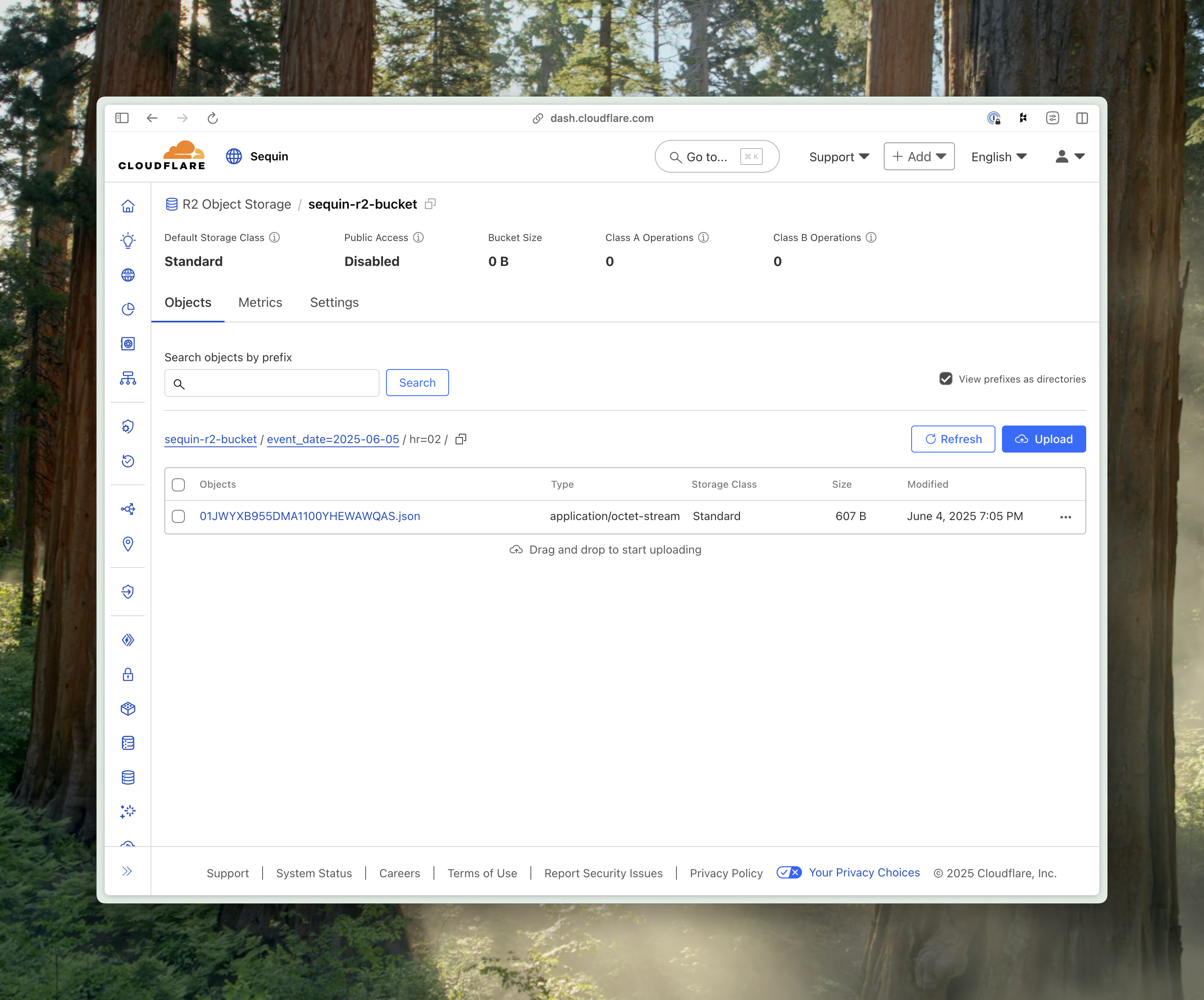 And if you download the object, you'll see the change as a single JSON object:
```json theme={null}
{
"record": {
"created_at": "2025-06-05T02:04:58.577494Z",
"email": "eric@sequinstream.com",
"first_name": "Eric",
"id": "666a0182-cde7-4fcf-8fc2-2561536a35bf",
"last_name": "Goldman",
"updated_at": "2025-06-05T02:04:58.577494Z"
},
"metadata": {
"database_name": "withered_feather_4",
"commit_idx": 0,
"commit_lsn": 35003912,
"commit_timestamp": "2025-06-05T02:04:58.584143Z",
"table_name": "users",
"table_schema": "public",
"transaction_annotations": null,
"idempotency_key": "MzUwMDM5MTI6MA==",
"consumer": {
"id": "c1905648-968c-4d73-8a1e-6cb2eb59a6a3",
"name": "cloudflare-pipeline-sink",
"annotations": {}
}
},
"action": "insert",
"changes": null
}
```
You've successfully seen a change from your database delivered to a Cloudflare pipeline and landed in an R2 bucket.
## Next steps
You are up and running with a Cloudflare pipeline and R2 bucket that's capturing every change in your database. You can use this sink to power a data lake or analytics (Iceberg, Delta Lake, etc.), long-term archival, or for audit and compliance use cases.
To build on this example, dig into the following resources:
Learn how to connect your production database to Sequin.
Learn how to deploy Sequin in production.
Learn more about how to configure your webhook sinks to deliver messages to your users.
Learn how to monitor your system with Sequin's built-in metrics.
And if you download the object, you'll see the change as a single JSON object:
```json theme={null}
{
"record": {
"created_at": "2025-06-05T02:04:58.577494Z",
"email": "eric@sequinstream.com",
"first_name": "Eric",
"id": "666a0182-cde7-4fcf-8fc2-2561536a35bf",
"last_name": "Goldman",
"updated_at": "2025-06-05T02:04:58.577494Z"
},
"metadata": {
"database_name": "withered_feather_4",
"commit_idx": 0,
"commit_lsn": 35003912,
"commit_timestamp": "2025-06-05T02:04:58.584143Z",
"table_name": "users",
"table_schema": "public",
"transaction_annotations": null,
"idempotency_key": "MzUwMDM5MTI6MA==",
"consumer": {
"id": "c1905648-968c-4d73-8a1e-6cb2eb59a6a3",
"name": "cloudflare-pipeline-sink",
"annotations": {}
}
},
"action": "insert",
"changes": null
}
```
You've successfully seen a change from your database delivered to a Cloudflare pipeline and landed in an R2 bucket.
## Next steps
You are up and running with a Cloudflare pipeline and R2 bucket that's capturing every change in your database. You can use this sink to power a data lake or analytics (Iceberg, Delta Lake, etc.), long-term archival, or for audit and compliance use cases.
To build on this example, dig into the following resources:
Learn how to connect your production database to Sequin.
Learn how to deploy Sequin in production.
Learn more about how to configure your webhook sinks to deliver messages to your users.
Learn how to monitor your system with Sequin's built-in metrics.